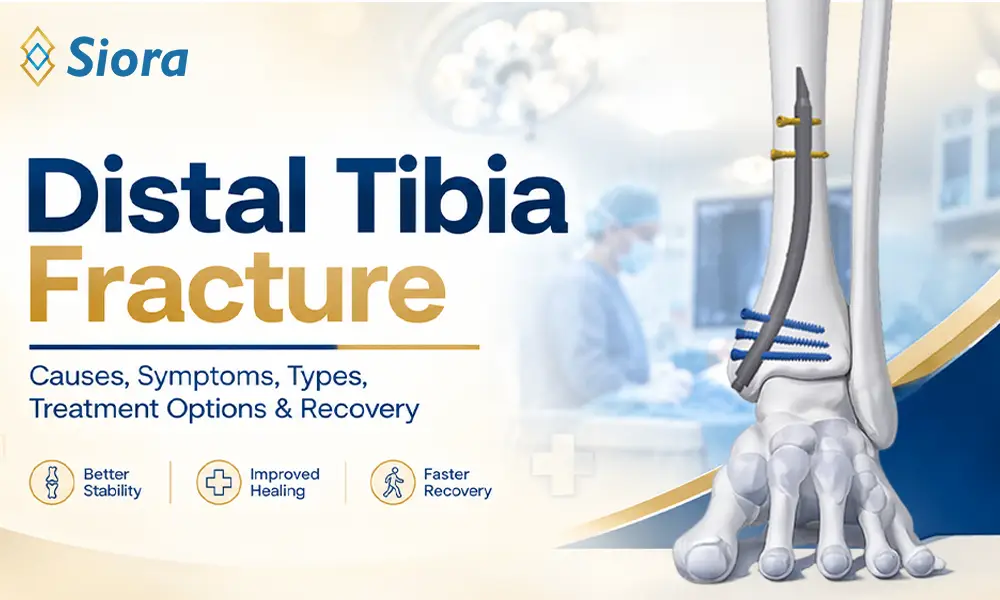
A distal tibia fracture is a condition characterized by a break in the lower part of the tibia, or shinbone, near the ankle joint. Because the distal tibia plays an important role in supporting body weight and forming the ankle joint, fractures in this area can affect walking, balance, and ankle movement. The severity of the injury can vary considerably, from a relatively stable fracture to a complex injury involving the ankle joint or surrounding soft tissues.
Early assessment is important because the appropriate treatment depends on several factors, including the fracture pattern, bone displacement, soft-tissue condition, and the patient’s overall health. Orthopedic evaluation and appropriate imaging help determine the most suitable treatment approach and support a safe recovery.
What Is a Distal Tibia Fracture?
Our lower leg has two bones, the tibia and fibula. The tibia is the larger one. Its lower end, known as the distal tibia, connects with the ankle bones and helps form the ankle joint.
A distal tibia fracture occurs when this portion of the bone breaks because of trauma, excessive force, or, in some cases, weakened bone. Some fractures remain aligned, while others cause the bone fragments to shift or involve the joint surface.
A particularly important type is a pilon fracture, in which the lower end of the tibia is fractured near or into the ankle joint. If the joint surface is involved, these injuries can be serious, causing significant swelling or soft-tissue damage.
What Are the Causes of Distal Tibia Fracture?
A distal tibia fracture can result from different types of trauma and, less commonly, underlying bone weakness. Common causes include:
High-impact injuries
Motor vehicle accidents, motorcycle crashes, and other high-energy trauma can place substantial force on the lower leg and ankle, potentially causing a complex fracture.
Falls
A fall from a height or an awkward landing can transmit force through the ankle and distal tibia. Because of low bone density, a low-energy fall may result in a distal tibia fracture.
Sports injuries
Certain sports involve jumping, twisting, sudden changes of direction, or high-impact landings. Such movements increase the risk of fractures around the lower leg and ankle.
Osteoporosis and weakened bones
Reduced bone density can make the tibia more vulnerable to injury. In people with osteoporosis, fractures may occur following trauma that would not normally cause a significant bone break.
Repetitive stress
Repeated loading of the lower leg can occasionally contribute to stress-related bone injury. If ignored, a stress injury may progress and become more significant.
What Are the Symptoms of Distal Tibia Fracture?
Symptoms depend on the location and severity of the fracture. Common signs include:
- Severe pain in the lower leg or ankle
- Swelling around the ankle and distal tibia
- Bruising or discoloration
- Difficulty standing or putting weight on the affected leg
- Restricted ankle movement
- Tenderness around the injured area
- Visible deformity in displaced fractures
- Difficulty walking
- A feeling of instability around the ankle
An open fracture, in which the broken bone communicates with an external wound, requires urgent medical attention because of the increased risk of infection and other complications.
Severe swelling, numbness, unusual skin color, coldness of the foot, or increasing pain should also be treated as warning signs requiring prompt medical evaluation.
What Are the Different Types of Distal Tibia Fractures?
Distal tibia fractures can be classified according to their location, fracture pattern, displacement, and involvement of the ankle joint.
Extra-articular fracture
In an extra-articular fracture, the break does not extend into the ankle joint surface. Depending on its stability and alignment, it may sometimes be managed without surgery.
Intra-articular fracture
An intra-articular fracture extends into the joint. Accurate restoration of the joint surface may be important to reduce problems such as stiffness, altered joint mechanics, and post-traumatic arthritis.
Pilon fracture
A pilon fracture affects the weight-bearing portion of the distal tibia and typically involves the ankle joint. These fractures may result from high-energy trauma and can be associated with considerable soft-tissue swelling.
Displaced fracture
A displaced fracture occurs when the broken bone fragments move out of their normal alignment. Depending on the degree of displacement and fracture stability, surgical fixation may be recommended.
Open fracture
An open fracture involves a wound through which the fracture communicates with the outside environment. It is an orthopedic emergency and requires prompt treatment.
How Is a Distal Tibia Fracture Diagnosed?
Diagnosis usually begins with a physical examination and a discussion about how the injury occurred. The orthopedic specialist assesses pain, swelling, deformity, circulation, sensation, and movement.
X-rays
X-rays are commonly used to identify the fracture and assess the alignment of the bone. Multiple views may be obtained to understand the fracture pattern.
CT scan
A CT scan may be recommended when the fracture involves the ankle joint or has a complex pattern. It can provide more detailed information about the fracture fragments and joint surface, which can be particularly useful when planning surgery.
MRI
MRI is not routinely required for every acute fracture but may be considered in selected cases, particularly when associated soft-tissue or bone injuries need further evaluation.
How Distal Tibia Fractures Are Treated?
The choice of distal tibia fracture treatment depends on fracture stability, displacement, joint involvement, soft-tissue condition, and the patient’s age, activity level, and general health.
Non-surgical treatment
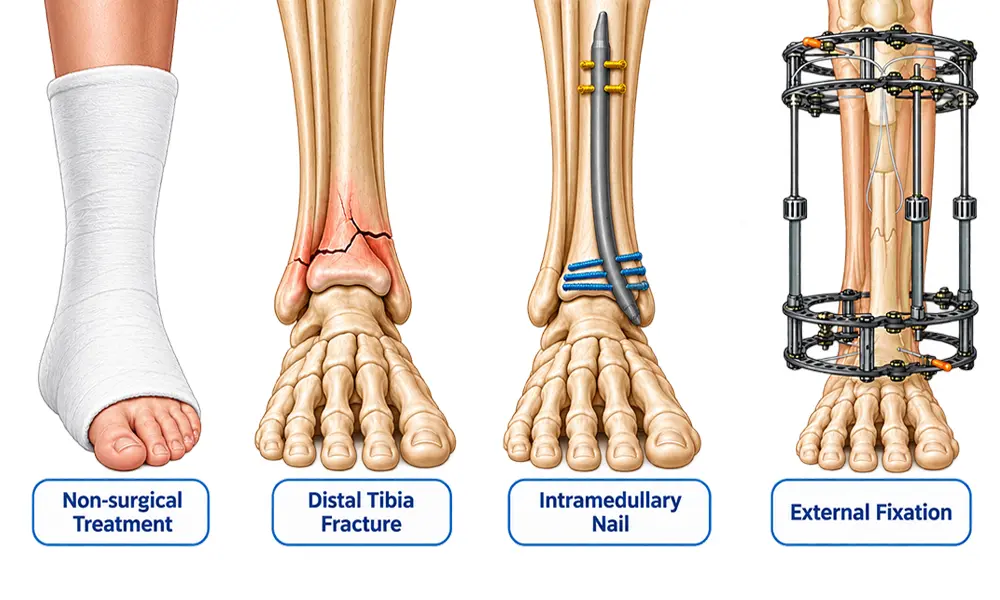
Stable, well-aligned fractures may sometimes be treated without surgery. Treatment can involve immobilization using a cast or brace, followed by gradual rehabilitation.
The patient may need to avoid putting weight on the injured leg for a period determined by the orthopedic specialist. Follow-up imaging is important to make sure the fracture remains properly aligned during healing.
Surgical treatment
Surgery may be recommended when the fracture is significantly displaced, unstable, involves the joint surface, or cannot be adequately maintained in acceptable alignment with non-surgical treatment.
The main goals of surgery are to restore appropriate bone alignment, stabilize the fracture, and, when necessary, reconstruct the joint surface.
Depending on the fracture pattern, surgeons may use techniques such as:
- Open reduction and internal fixation (ORIF)
- Locking distal tibia plates and screws
- Intramedullary fixation using distal tibia nails in selected fracture patterns
- External fixation, particularly in certain complex injuries or when soft-tissue swelling makes definitive fixation unsuitable initially
In complex distal tibia or pilon fractures, treatment may sometimes be performed in stages. Temporary stabilization can be used initially while significant swelling and soft-tissue problems settle, followed by definitive fixation when conditions are more favorable.
Role of Distal Tibia Plates and Screws
Internal fixation devices such as plates and screws are commonly used when surgical stabilization is necessary. Modern fixation systems are designed to provide appropriate mechanical stability while allowing the surgeon to address the specific fracture configuration.
Locking plate technology can be useful in selected distal tibia fractures, particularly when stable fixation is required in the relatively distal portion of the bone or when bone quality is a concern.
The implant and fixation technique are selected by the orthopedic surgeon according to the patient’s anatomy, fracture characteristics, bone quality, and surgical requirements.
Recovery After Distal Tibia Fracture
Recovery varies from person to person. A straightforward fracture may heal differently from a severe intra-articular or pilon fracture.
The initial recovery period generally focuses on protecting the fracture, controlling swelling and pain, and monitoring bone alignment. Weight-bearing is introduced gradually according to the stability of the fracture, healing progress, and the treating surgeon’s instructions.
Physical therapy can become an important part of rehabilitation. Exercises may focus on:
- Restoring ankle range of motion
- Improving leg and ankle strength
- Rebuilding balance and coordination
- Gradually improving walking ability
- Returning to everyday activities
Patients should follow their orthopedic team’s instructions carefully and attend scheduled follow-up appointments.
Possible Complications
Although many distal tibia fractures heal successfully with appropriate treatment, complications can occur. These may include delayed bone healing, nonunion, infection, stiffness, malalignment, nerve or blood-vessel problems, and post-traumatic arthritis, particularly when the fracture involves the ankle joint.
Smoking, poorly controlled medical conditions, severe soft-tissue injury, and complex fracture patterns may affect healing. Individual risk depends on the specific circumstances of the injury and the patient’s overall health.
When Should You See an Orthopedic Specialist?
Any suspected fracture of the distal tibia should be evaluated by a qualified healthcare professional. Immediate assessment is especially important when there is severe pain, visible deformity, inability to bear weight, an open wound, rapidly increasing swelling, numbness, or changes in the color or temperature of the foot.
Early diagnosis allows the orthopedic team to understand the fracture pattern and determine whether conservative care, surgical fixation, or staged treatment is appropriate.
Conclusion
A distal tibia fracture can range from a stable lower-leg injury to a complex fracture involving the ankle joint. Understanding the cause, fracture type, symptoms, and available treatment options can help patients make informed decisions about their care.
The appropriate distal tibia fracture treatment should always be based on an individualized orthopedic assessment. Depending on the injury, treatment may involve immobilization and gradual rehabilitation or surgical fixation using plates, screws, or other stabilization techniques. With appropriate treatment, follow-up, and rehabilitation, many patients can progressively regain mobility and return to their daily activities.